Sometimes I wonder what is going through the mind of those Hollywood guys. I wish I knew what to think about this:
Showing posts with label Movies. Show all posts
Showing posts with label Movies. Show all posts
Sunday, February 1, 2009

Saturday, November 22, 2008
Revisionism: the good and bad

Some of these offerings have been excellent. The Battlestar Galactica series is some of the best science-fiction television ever created, miles ahead of its contemporaries just as its predecessor was ahead of its own. Virtually all of the updating is, in my opinion, a good thing. The plots are more intelligent, harrowing, and even moving--addressing concerns lurking in the heart of modern America.
The new Batman franchise is a similar breath of fresh air. While Batman Begins was an excellent film in its own right, many are saying that the Dark Knight has transcended the genre, become something more than any other so-called "comic book" movie before it.
These movies stand as great examples of how to do revisionism: take the heart of what is good about the original material, show respect for the franchise and its history, and then deepen it for the newcomer and fan alike.
Then there are countless examples of revisionism gone terribly wrong.
Planet of the Apes. Dukes of Hazzard. Scooby-Doo. Psycho. Wild Wild West. Godzilla 2000. Starship Troopers. (Okay, that last one wasn't quite a remake of a movie or TV show, but a book adaptation that might be the worst ever).
Each one of these movies tried to take the trappings of their predecessors and sell them without understanding the heart of the original. Worse, they had no respect for the fans of the franchise and what they considered to be its enduring value.
Two franchises that are awaiting judgment: the new Bond series with Daniel Craig and the forthcoming Star Trek movie featuring characters from the original series. The new Bond is very good, but it is definitely a re-visioning of Bond, his character, and his world. This is not the Bond we know and love, but something new. So far, so good, but it will remain so only if they figure out how to scale back the brooding and the brutality and make him fun again. Bond is not meant to be a treatise on international relations and how they play out in the life of actual operatives--Bourne already did that. Bourne ain't Bond.
And (thanks Shazammm for getting me all stirred up about it) the preview for the new Star Trek movie? This looks like it might be in the running for worst revisionism ever. At this point it is way too soon to tell. I sincerely hope I'm wrong and they didn't have enough of the movie put together to do it justice in the trailer. But is this really Star Trek? Or anything even in its orbit? We'll see.
Wednesday, October 10, 2007
"If you build it, he will come."
 Though I love movies, I seem to be one of those people that has odd, glaring holes in my movie-watching experience. For example, it was not until just a few years ago that I actually sat down and watched The Breakfast Club. I grew up hearing quotes and references to this iconic movie, but never quite knew what people were talking about. Jake would frequently look at me in shocked wonder whenever I would say, "Nope, still haven't seen it."
Another movie that fits solidly into the "I can't believe you have never seen that movie" category is Field of Dreams. At least as much as Breakfast Club, Field of Dreams is a profound memory in our culture: mixing baseball, regret over bad blood between dad and son, a family farm in jeopardy, and the colossal undertow of Nostalgia Americana. I have heard it referred to as the "movie guaranteed to make manly men cry."
I finally saw this movie last night and thoroughly enjoyed it. This movie captures completely the purpose and truth of the fantasy genre: able to take human sentiment and cast it against a fantastic background, causing it to stand out in stark relief. There are many touching stories about men making peace with their dead fathers and other good stories that evoke a powerful sense of nostalgia. But this story becomes transcendent as it is tied to an experience as iconic, as thoroughly and symbolically American like baseball, and then we are immersed in the vicarious wish fulfillment of every baseball-loving child. A glimpse of the truth and beauty of heaven? A fleeting taste of our telos toward which we are moving in Christ? Quite possibly, especially given the movie's end sequence (the waterworks-inducing "Hey, dad? Wanna have a catch?"). The beauty of fantasy indeed.
Monday, September 3, 2007
The coveted 90-minute action-scene
Saw Live Free or Die Hard earlier this summer. Loved it (well, except for the VTOL plane freeway bridge scene), great summer action flick. Pure fun, with a character we already love. But perhaps for some it is not enough:

(Wondering who River Tam is? Had no idea myself until I looked it up.)
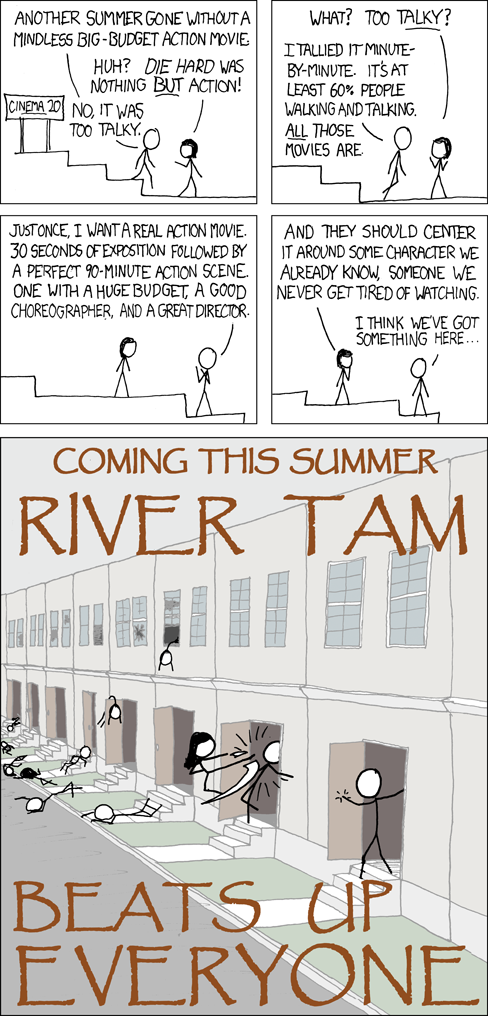
(Wondering who River Tam is? Had no idea myself until I looked it up.)
Sunday, July 9, 2006
Still room for heroes even in this culture: Or: why I was wrong about comic book movies
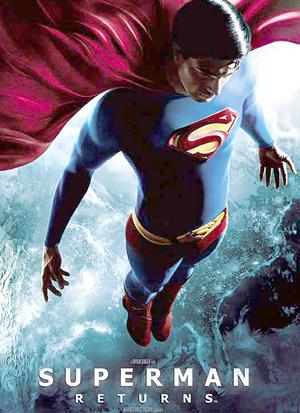
I really didn't think it could be done. I really had given up after dozens of disappointments and false hopes. In general, I really didn't think any comic book movie could ever again produce the kind of good feelings, excitement, and genuine cheesy grin that I had watching movies when I was younger. And specifically, I didn't think the new Superman movie could be done in this culture without some serious changes made to the way he is portrayed.
Oh, how wrong I was, and how thankful I am to admit it.
Superman was the first comic book movie in a long, long time to give me goosebumps. No, it was not from the overwhelming action scenes or from over the top battle sequences. It was because the new Superman had a kind of meaning that no recent superhero movie has.
Spiderman represents an ordinary kid, to whom many of us could relate, but who gains extraordinary powers. We journey along with him, experience what he experiences as he grows into his powers and is challenged in exciting and visually stunning ways. Batman is a tour de force in dark heroism, a distant and strange person passionate about crushing the injustice about which we all feel so frustrated and helpless.
But Superman comes off in the movie as a hero. He is a towering figure of good whom we look upon and wish we could be like. We can't relate to him but we instinctively want to rise to his example. We look at him and say, "that is how people are supposed to act!" More than any movie of its kind in many years, this is a movie about a guy that the world needs.
I really didn't think it could be done, not in this culture. Ours is a world of cynicism, where the least act of heroism is quickly picked apart for selfish motives. Heroes are not heroes as they have been in the past. This is a world as The Incredibles describes--ones in which superheroes are sued for collateral damage and for offending the sensibilities of villain-victims. Bryan Singer and the team which produced Superman are to be congratulated for their daunting task: taking the classic figure of Superman in all his unspoiled goodness and placing him in our cynical world in such a way that our world comes out looking as hollow and corrupted and soulless as it actually is. That is a grand, perhaps even superhuman, achievement. And that is why I am profoundly grateful for this newest movie.
Thursday, December 15, 2005
They really can do anything on the Big Screen

Last night, after a bit of a slow start, I was drawn in to Hollywood's latest rendition of King Kong, America's favorite monster movie. After spending twenty minutes in New York meeting strange vaudeville characters, I knew this was going to be a long movie. Nevertheless, by the time the young Conrad-infatuated lookout started shouting, "Wall!", I was ready for action. And action we were supplied!
There were several excellent sequences in Kong. I was genuinely horrified by the meeting with the savages, alternating between the chillingly alien and the violently frightening. The trance-rapt women of the tribe and their undulating celebration of foreign sacrifice was disgusting and appalling--more authentic to the intention of the original films than I would have expected by Hollywood's PC culture.
Even more disturbing was the filthy, creepy encounter with the grotesque vermin living in Skull Island's mud bogs. Enormous cockroaches, spiders, centipedes, and leeches (!) streamed out of every crack to torment the crew and the audience. The scene where Lumpy has his face eaten by the protruding jaw-jelly of a giant leech was one of the nastiest things I had ever seen on film (and makes me want to go see Slither too...).
But nothing in the film topped the best monster fight sequence ever: Kong confronting not one but three full-grown T-Rexes (and Ostrom's utterly fictitious warm-blooded dinosaurs to boot). This, more than anything Revenge of the Sith or even Lord of the Rings ever put to film, convinced me that the filmmaker's ability to realize visual effects is limited only by his imagination. To quote one of my favorite bloggers, this entire sequence was comprised of awesome! Much like Terminator 3 was the first to make CG characters look like they actually had mass, King Kong managed to make ferocious monsters look like they actually were three stories tall. The sound of the T-Rex jaws snapping shut was nearly enough on its own. This is the best large-scale fight sequence ever "filmed." Amazing.
* * *
Still, I felt much the same after watching King Kong as I did after watching the technically and artistically fantastic Batman Begins. After a little preliminary reflection (it was 2:00am when I finished watching Kong after all), I think I've finally come to a realization why I feel consistently underwhelmed by films like these--and also why I am so frustrated with films that are rehashing old ideas. It comes down to this: I've already seen Kong and Batman.
Neither of the original films were done as well (arguably) as their newer, more advanced and more intelligent counterparts. But I've already seen them. The basic films are thematically and substantively identical to their originals. Yes, they reinvent and deepen aspects of the context. And yes of course the subject matter itself is more fully realized. But they are the same films.
The beauty of King Kong is the dramatic boldness of its imagination: a film crew goes to an island where there are prehistoric monsters roaming about--and they bring one back. That's a cool idea! And there is a brilliant tragic subtext: nature's wonder destroyed by a fickle humanity that went in search of it then destroyed it out of fear. None of this changed in the remaking of the film, and thus I have missed out on the watching of the film. It was merely a re-watching.
My plea for Hollywood is to risk creating something as new and brilliant as the original concept of Kong. Use what has been learned in the realization of films such as this and lead my imagination into fresh fields.
Wednesday, July 13, 2005
A foolish samurai warrior...


"Long ago in a distant land, I, Aku, the shape-shifting master of darkness, unleashed an UNSPEAKABLE evil."But a foolish samurai warrior, wielding a magic sword, stepped forth to oppose me.
"Before the final blow was struck, I tore open a portal in time, and flung him into the future, where my evil is law.
"Now the fool seeks to return to the past, and undo the future that is AKU."
Melissa, darling wife that she is, bought me the first season of Samurai Jack on DVD. I had only seen a few episodes before, but I have fallen head over heels in love with this show. This might be the best cartoon released in the last ten years, and perhaps the best action cartoon ever drawn. I'm looking forward to the second season now (which I recently purchased at Walmart...)
Thursday, June 16, 2005
I must be tired... Reactions to Batman Begins
I must be tired of comic book movies.
Anywhere between the ages of 8 and 20, I would leap out of my seat every time I heard an announcement that a new action-packed science fiction, fantasy, or superhero-type movie was in the makings. I was really excited about Keaton's Batman, strange and different as it was. Heck, I even felt a little tingle when I heard they were making the Punisher (at least until I heard Dolph Lundgren was going to be in it. Even at that age, I wasn't falling for it...)
Now, after dozens of terrible comic book movies (The Crow, Daredevil, Spawn, Elektra, The Shadow), several fair comic book movies (Blade, original Batman, Hulk, the new Punisher), and even some outstanding ones (Spiderman, X-Men, X2), I reacted with a sigh and detached disinterest when I heard they were making a new Batman movie. That's a sure sign that I must be just plain tired of comic book movies, since Batman has always been in the top five of coolest superheroes.
I just sat through an impressive one last night. This newest revision of the Batman story, Batman Begins, was rich and complex, had some excellent acting, and even some new twists on the Batman mysterie that were visionary and well-told. They chose new but still interesting (and downright frightening) super-villains, and generally did a great job putting a superhero with a difficult-to-tell-without-cheese story together.
Still, I could not find any trace of the excitement with which I saw X-Men or even the subdued appreciation I felt for the excellent Spiderman released recently. Is it because movies just don't hold much punch for me anymore? No, I came away from several movies this year having enjoyed them immensely. Is it that it wasn't "new"? No, I came away from the new Star Wars enjoying it considerably and it wasn't anything new. Was it because the filmmakers failed in some way? Probably not, since my favorite movie reviewer raved about this film. So what in the world was it?
I dunno, I guess I just must be tired.
Anywhere between the ages of 8 and 20, I would leap out of my seat every time I heard an announcement that a new action-packed science fiction, fantasy, or superhero-type movie was in the makings. I was really excited about Keaton's Batman, strange and different as it was. Heck, I even felt a little tingle when I heard they were making the Punisher (at least until I heard Dolph Lundgren was going to be in it. Even at that age, I wasn't falling for it...)
Now, after dozens of terrible comic book movies (The Crow, Daredevil, Spawn, Elektra, The Shadow), several fair comic book movies (Blade, original Batman, Hulk, the new Punisher), and even some outstanding ones (Spiderman, X-Men, X2), I reacted with a sigh and detached disinterest when I heard they were making a new Batman movie. That's a sure sign that I must be just plain tired of comic book movies, since Batman has always been in the top five of coolest superheroes.
I just sat through an impressive one last night. This newest revision of the Batman story, Batman Begins, was rich and complex, had some excellent acting, and even some new twists on the Batman mysterie that were visionary and well-told. They chose new but still interesting (and downright frightening) super-villains, and generally did a great job putting a superhero with a difficult-to-tell-without-cheese story together.
Still, I could not find any trace of the excitement with which I saw X-Men or even the subdued appreciation I felt for the excellent Spiderman released recently. Is it because movies just don't hold much punch for me anymore? No, I came away from several movies this year having enjoyed them immensely. Is it that it wasn't "new"? No, I came away from the new Star Wars enjoying it considerably and it wasn't anything new. Was it because the filmmakers failed in some way? Probably not, since my favorite movie reviewer raved about this film. So what in the world was it?
I dunno, I guess I just must be tired.
Thursday, March 17, 2005
How much Diesel is too much?
Scifidaily.com recently posted an article (please don't click on the link; it has a terrible picture of Vin doing the thing that I hate about him most...) mentioning plans to continue with Chronicles of Riddick:
A sequel to Chronicles of Riddick? Call me cynical, but could it possibly hold up to the sheerly accidental coolness of the original? Exactly how much more legendary will Riddick become, given the fact that he went from scary con to superhuman combat machine in the second movie? Will he challenge the Beyonder in Underverse? (Actually, that might be worth seeing...)
Also, I hope you caught that other subtle comment: Diesel in a Hannibal historical movie? In the words of the immortal Ren, "...maybe something good, maybe something bad..."
A sequel to one of the most original and exciting pure sci-fi films in years is in the works, according to its larger-than-life star. Vin Diesel (Pitch Black, The Iron Giant, Saving Private Ryan) has told MTV News that work soon will begin on the sequel to the phenomenal 2004 genre outing The Chronicles of Riddick, which itself was a sequel to the very underrated 2000 sci-fi’er, Pitch Black. Once Diesel finishes work on the 2006 historical epic, Hannibal the Conqueror, he reports he will begin production on COR2, the second in what will be The Chronicles of Riddick Trilogy. The second film, he says, will take place in the ominously titled Underverse; the third will see Riddick’s return to his homeworld, Furia. He states COR2 will be rated R, unlike the PG-13 rated COR1. While COR1 did only $115.4 million worldwide (it cost $140 million), it did huge DVD business. Ultimately, I have a hunch that COR1 always will be on my most underrated films list. If you have yet to see it, watch it now. RIGHT NOW!
A sequel to Chronicles of Riddick? Call me cynical, but could it possibly hold up to the sheerly accidental coolness of the original? Exactly how much more legendary will Riddick become, given the fact that he went from scary con to superhuman combat machine in the second movie? Will he challenge the Beyonder in Underverse? (Actually, that might be worth seeing...)
Also, I hope you caught that other subtle comment: Diesel in a Hannibal historical movie? In the words of the immortal Ren, "...maybe something good, maybe something bad..."
Friday, February 18, 2005
A journey into the absurd...
Tonight while watching Aliens vs. Predator (AVP for you fans...), the movie was unable to hold more than a small portion of our attention, so we had plenty of time to talk about other things. Somebody there mentioned that he had caught a glimpse of a liger on TV and it had impressed him. Now, having recently seen Napoleon Dynamite, I knew that ligers were bred for their magical skills, and thus were probably not actual inhabitants of what I like to call "the real world."
Oh, how wrong I was. All I entered into my Google search was the term liger and I was treated to some shots of these huge animals like the one below.
Always wondering if I had stumbled onto a hoax or a well-run urban myth, I began to actually dig around and see if this was authentic stuff. As far as I can tell, they are as real as mules. Here's a site of a zoo in Reno that claims to have one (and some nice shots of them).
Here's one other site with some great photos too.
But the real gem I found upon going back to my original Google search. At the time, item #5 down on Google's results was "The Anti-Liger Alliance." This was the preview text, "Welcome to the official homepage of the Anti-Liger Alliance! We are the only organization dedicated to the eradication of man's deadliest foe, the liger..." That's enough to give you visions of PETA gone very, very bad.
I tried to click through to the site, but it was down, and it was here that Google's site cache feature worked so nicely. Here is the text from the cache link:
And just in case you were worrying about who is keeping an eye on these ferocious threats to mankind's future on earth, old Optimus Prime is looking out for you (make sure you click the icon)...
This, ladies and gentlemen, is why the internet is a great good thing.
Oh, how wrong I was. All I entered into my Google search was the term liger and I was treated to some shots of these huge animals like the one below.

Always wondering if I had stumbled onto a hoax or a well-run urban myth, I began to actually dig around and see if this was authentic stuff. As far as I can tell, they are as real as mules. Here's a site of a zoo in Reno that claims to have one (and some nice shots of them).
Here's one other site with some great photos too.
But the real gem I found upon going back to my original Google search. At the time, item #5 down on Google's results was "The Anti-Liger Alliance." This was the preview text, "Welcome to the official homepage of the Anti-Liger Alliance! We are the only organization dedicated to the eradication of man's deadliest foe, the liger..." That's enough to give you visions of PETA gone very, very bad.
I tried to click through to the site, but it was down, and it was here that Google's site cache feature worked so nicely. Here is the text from the cache link:
Welcome to the official homepage of the Anti-Liger Alliance! We are the only organization dedicated to the eradication of man's deadliest foe, the liger. But what is a liger? Websters defines the liger as "half lion, half tiger, all terror." When you breed a male lion with a female tiger, you get the liger, a perfect killing-machine with only one thought on its mind: exterminate mankind. Right now, ligers live only in captivity but if they were to ever escape, they would surely replace man as the dominant species on planet Earth.
You see, in the ancient times of our caveman ancestors, a lion accidentally bred with a tiger. The resulting monstrocities quickly duplicated and soon unleashed their fury on the world. They were able to quickly exterminate the races of the wooly mammoth, the sabre-toothed tiger, and the dinosaur. It then subdued the other races of animals until only one remained, the caveman. In the Great Human-Liger War of 23,002-22,986 BC, man came dangerously close to extinction by the liger. However, one great caveman leader by the name of Eknok united the human tribes and was able to miraculously defeat the mighty liger army. Some say that he created a giant earthquake to suck the ligers into the fiery core below. I personally believe he constructed a giant catapult that he used to hurl the gigantic ligers into outer space. Nonetheless, man was treated to 25,000 years without the threat of the liger because Eknok, in his great wisdom, decreed that lions and tigers would henceforth be seperated: the lions in Africa and the tigers in Asia.
However, in recent years man has planted the seeds of his own destruction by breeding a new force of ligers. It is only a matter of time before they strike again. That is why the Anti-Liger Alliance is dedicated to the eradication of all ligers and the survival and continued dominance of the human race.
And just in case you were worrying about who is keeping an eye on these ferocious threats to mankind's future on earth, old Optimus Prime is looking out for you (make sure you click the icon)...
This, ladies and gentlemen, is why the internet is a great good thing.
Tuesday, February 1, 2005
Culture out of context: What Spiderman and Christianity have in common
According to The Weekly Standard, the boys down at Marvel are trying some new tricks with an old favorite. Spider-Man is getting a facelift and a re-write to serve new audiences in India. Marvel calls it a "transcreation" since they are attempting to preserve the core of the moral themes in Spider-Man while re-writing the backstory and character to accomodate non-American readers:
As a church planter, I've run into this concept before. One of the big challenges of planting a church is a process called contextualization. This is the process of taking what is universal about the Christian faith and attempting to communicate and embody those truths in a way that makes sense to a particular culture. To a new generation of people who have never been to church, a lot of the "culture" of existing churches is foreign to them (i.e., stuck in the 1950's) and is of no help in communicating the gospel.
One of the tasks of the church planter is to attempt to bridge the gap between the surrounding culture and the universal aspects of the Christian faith. For example, instead of a translation of the Bible that reads:
Big difference in the two readings, if only in the level of literal translation from the original greek in which the text was written. No doubt in another twenty years, the above text won't work well at all. This is a perfect example of contextualization - choosing something that communicates Christian faith clearly in our present culture. Other examples include choice of musical style and style of dress. It becomes a real challenge: attempting to clear away what is culturally out-of-place and therefore a stumbling block without distorting or omitting important aspects of the transcendent universal truth.
I wonder how old Stan Lee reacted when they began messing with his great success story? How much more do Christians get uneasy when asking themselves, what is true and what is merely cultural?
Though we will remain true to the underlining mythos of Spider-Man, which is epitomized in the phrase "With Great Power Comes Great Responsibility," the character will be reinvented so his powers, problems and costume are more integrated with Indian culture. Unlike the U.S. origin, which is deeply rooted in science, the Indian version is more rooted in magic and mythology.I find the sociology of this fascinating. Even the Marvel folks can get their minds around the possibility of a transcendent universal truth, specifically here about power and its attendant pitfalls. That this truth can be uprooted from its uniquely American cultural context and re-written into a very different Indian culture is a fascinating idea.
As a church planter, I've run into this concept before. One of the big challenges of planting a church is a process called contextualization. This is the process of taking what is universal about the Christian faith and attempting to communicate and embody those truths in a way that makes sense to a particular culture. To a new generation of people who have never been to church, a lot of the "culture" of existing churches is foreign to them (i.e., stuck in the 1950's) and is of no help in communicating the gospel.
One of the tasks of the church planter is to attempt to bridge the gap between the surrounding culture and the universal aspects of the Christian faith. For example, instead of a translation of the Bible that reads:
But now apart from the Law the righteousness of God has been manifested, being witnessed by the Law and the Prophets, even the righteousness of God through faith in Jesus Christ for all those who believe; for there is no distinction; for all have sinned and fall short of the glory of God, being justified as a gift by His grace through the redemption which is in Christ Jesus; whom God displayed publicly as a propitiation in His blood through faith. This was to demonstrate His righteousness, because in the forbearance of God He passed over the sins previously committed; for the demonstration, I say, of His righteousness at the present time, so that He would be just and the justifier of the one who has faith in Jesus.The church planter might choose one that is more immediately accessible to readers:
But now God has shown us a different way of being right in his sight—not by obeying the law but by the way promised in the Scriptures long ago. We are made right in God’s sight when we trust in Jesus Christ to take away our sins. And we all can be saved in this same way, no matter who we are or what we have done. For all have sinned; all fall short of God’s glorious standard. Yet now God in his gracious kindness declares us not guilty. He has done this through Christ Jesus, who has freed us by taking away our sins. For God sent Jesus to take the punishment for our sins and to satisfy God’s anger against us. We are made right with God when we believe that Jesus shed his blood, sacrificing his life for us. God was being entirely fair and
just when he did not punish those who sinned in former times. And he is entirely fair and just in this present time when he declares sinners to be right in his sight because they believe in Jesus.
Big difference in the two readings, if only in the level of literal translation from the original greek in which the text was written. No doubt in another twenty years, the above text won't work well at all. This is a perfect example of contextualization - choosing something that communicates Christian faith clearly in our present culture. Other examples include choice of musical style and style of dress. It becomes a real challenge: attempting to clear away what is culturally out-of-place and therefore a stumbling block without distorting or omitting important aspects of the transcendent universal truth.
I wonder how old Stan Lee reacted when they began messing with his great success story? How much more do Christians get uneasy when asking themselves, what is true and what is merely cultural?
Saturday, January 29, 2005
DecentFilms.com posts 2004 Year in Review
My favorite film critic site on the 'net recently posted its 2004 Year in Review. As usual, I agreed with most of his assessments of last year's films. As I already mentioned in an earlier post, I thought last year was a pathetic re-mix and overall quite disappointing. Apparently, Mr. Greydanus agrees with me:
Check out his list. As usual, it contains several items I haven't heard of, one of which sounded particularly interesting. It pays to have folks out there who share a lot of your movie tastes that can do the grunt work when it comes to finding decentfilms worth watching.
Did anything worth caring about come to cineplex screens? Anything anyone will be talking about or revisiting five or ten years from now?
Check out his list. As usual, it contains several items I haven't heard of, one of which sounded particularly interesting. It pays to have folks out there who share a lot of your movie tastes that can do the grunt work when it comes to finding decentfilms worth watching.
Thursday, January 20, 2005
Which comic book movie ought to be next?
Tonight at the Dragonfly Cafe, Jake, Matthew, Eric, and I were discussing which comic book movie ought to be done next. (Not that I think that any should be made next... That's another post.)
We discussed the fact that most comic book movies are posers (Daredevil, Elektra, Punisher, Catwoman, most of the Batman franchise), so this would have to be one that could hold its water in terms of a good story and good acting in the midst of our cynical culture.
We discussed a few thoughts (Doctor Strange and Silver Surfer came to mind), but ultimately it came down to one very cool possibility.
What if they made a movie about the Marvel superhero Thor? He's not cheesy, doesn't need a lot of costume help, has a great backstory (Norse sagas, anyone?), and could fit well with the anachronism theme. Heck, Neil Gaiman thought it might work. Pull it down out of the vapors of speculative fiction into something your general moviegoer could appreciate, and you are home free. Pete Jackson (or Bryan Singer), are you reading this?
We discussed the fact that most comic book movies are posers (Daredevil, Elektra, Punisher, Catwoman, most of the Batman franchise), so this would have to be one that could hold its water in terms of a good story and good acting in the midst of our cynical culture.
We discussed a few thoughts (Doctor Strange and Silver Surfer came to mind), but ultimately it came down to one very cool possibility.
What if they made a movie about the Marvel superhero Thor? He's not cheesy, doesn't need a lot of costume help, has a great backstory (Norse sagas, anyone?), and could fit well with the anachronism theme. Heck, Neil Gaiman thought it might work. Pull it down out of the vapors of speculative fiction into something your general moviegoer could appreciate, and you are home free. Pete Jackson (or Bryan Singer), are you reading this?
Friday, January 14, 2005
Thursday, January 13, 2005
The top 10 film special effects sequences
According to SciFiDaily:
That list is hard to argue. I'd have to dump the Forbidden Planet one (since I've never seen it), and add the entire sequence from Matrix Reloaded starting with Neo's battle with multiple Smiths and cut right after the two semi trucks collide. Incidentally, that extended sequence I contend is the over-the-top king of all action sequences ever filmed.
SFX Magazine recently released the results of a poll it conducted seeking science-fiction/fantasy fans’ Top 10 Film Special Effects. Given my penchant for Top 10 lists, I just couldn’t pass this one up. So here’s their list: 10) Train fight from Spider-Man 2; 9) The “chest burster” from Alien; 8) Matrix bullets; 7) Gollum from The Lord of the Rings; 6) Krell machinery in Forbidden Planet; 5) The T-1000 from Terminator 2: Judgment Day; 4) The skeletons from Jason and the Argonauts; 3) The spider head from 1982’s The Thing; 2) The climax of 1933’s King Kong; and 1) The opening Star Destroyer shot from Star Wars, Episode IV: A New Hope.
That list is hard to argue. I'd have to dump the Forbidden Planet one (since I've never seen it), and add the entire sequence from Matrix Reloaded starting with Neo's battle with multiple Smiths and cut right after the two semi trucks collide. Incidentally, that extended sequence I contend is the over-the-top king of all action sequences ever filmed.
Monday, January 10, 2005
If The Chronicles of Riddick is such a bad movie, why do I like it so much?
Bad sci-fi movies come in all shapes and sizes. From The Thunderbirds to Dune, Solarbabies to The Fifth Element, the movie industry has indicated that there is indeed a vast array of errors any given sci-fi movie can make to become just plain bad.
I finished watching The Chronicles of Riddick for the second time. It was a bad movie for a great many reasons. But why, having realized this the first time I saw the movie, did I choose this movie to watch again, and, like the first time I watched it, why did I thoroughly enjoy it?
First, let me point out a few of the ways Riddick went bad. First, let's face it: the movie is a celebration of Vin Diesel more than it is anything else. Much as Troy was written around Brad Pitt rather than the actual figure of Achilles in Homer's Iliad, Riddick was written around Vin Diesel. Without him, this movie (and less so, its predecessor, Pitch Black) would have fallen flat. Sometimes this isn't a problem--excellent movies have been made that circle around a single character, powerfully depicted by an actor with a strong presence (Indiana Jones comes to mind). However, from the plot choices made and the supporting characters chosen, it is clear that the filmmakers intended there to be more to the movie.
Second, though the movie toys with a number of themes, it ultimately fails to sound a strong note on any of them. This is largely because of the first reason: it is so focused on Riddick's grandeur that the themes and important plot moments aren't given quite enough screen time. The film explores the theme of loyalty and betrayal in several dimensions. First, we see this theme in Riddick's relationship with Kyra and separately with the Imam and his people. Second, we see it in the triple relationship between the authorities, the mercenary companies, and Riddick. Finally, we see it in complex threads in the court of the Necromongers. Another theme explored ineffectively is the nature of evil. Riddick is the quintessential anti-hero, but the film can't quite bring itself to cast him in a negative light where we question his role and heart. His own supposed evil is played against the greater darkness of the Necromongers as well as in minor ways, such as within the penal system and with the mercenary companies. Again, Riddick's character looms over these choices, making it difficult to follow these trails.
And third, the film attempts a number of narrative strategies, but succeeds in fleshing them out only intermittently. Specifically, the inclusion of Jack's character and the subplot of her suffering because of Riddick's flaws fell flat, largely because of Davalos' performance (though she wasn't helped by the writing). The element of prophecy and fulfillment comes across as ridiculous in this film and probably should have been avoided entirely. It is a workable strategy (c. f., Lord of the Rings), but it was incompatible with this genre. Also attempted and luke warm was the Purifier character, who wasn't given enough depth for his role in the story and was not ultimately needed except as a device to make Riddick's escapes fit into the plot.
In all of its over-the-top celebration of Vin Diesel, flat themes, and hit-and-miss attempts at significance, why did I enjoy this movie so much?
I think it comes down to two things. Often, muscle-bound actors playing action heroes blow the moment every time they open their mouths or interact with other characters. Not so with Vin Diesel. Riddick is such a captivating character and Vin Diesel so capable of portraying him, that you simply cannot help but smile in spite of the thin broth that is the movie as a whole. The moments of interaction with the mercenary Toombs are simply priceless ("I don't know about this new crew of yours, Toombs. Seems a little skittish." "...here you are, supposed to be some slick killer and look at you now, all back of the bus..."). Even the cheesy dialogue between him and Kyra almost rises to the challenge ("Remember that game you like to play?" "Yeah, who's the better killer." "Let's play.").
Secondly, while the movie is intermittent in hitting its targets, it does without question do so on a number of occasions. I suspect that the making of The Chronicles of Riddick was an attempt to capitalize on the unexpected success of Pitch Black, which was one of the rare new ideas in Hollywood science fiction in recent years. Noticing that Diesel's Riddick was such a memorable character, writers were given the job of creating a movie in which his legacy could be carried forward. If that was indeed the case, the filmmakers managed to achieve something beyond this rather limited goal. The universe in which the film takes place becomes a truly interesting world with a life outside of Riddick's spotlight. One could easily imagine other films being made in this same world that successfully contribute to the better science fiction genre. The Necromongers, the race of Elementals, the surprising richness of Helion Prime, all manage to push past their roles as plot devices and achieve something of their own. Vaako and his wife, the mercenaries, the Lord Marshall, and even the crew of pseudo-Russian prison wardens were excellent creations. Even some of the set-piece locations, weaponry, vehicles, and technology were intriguing, fitting well into the backdrop and provoking some of the same wonder as those seen in Star Wars. That a writer would refrain from explaining to us how the world-destroying weaponry of the Necromongers work is a restraint hardly seen in movies of this caliber.
All in all, even with its many flaws, I would prefer a movie like The Chronicles of Riddick over a yet-another-comic-book-film, warmed-over-TV-series-made-film, or revisionist-classic-made-film. Give me something new - convince me that the science fiction and fantasy genres are not yet fully explored. Remind me that wonder in these imaginative worlds is not wholly exhausted.
I finished watching The Chronicles of Riddick for the second time. It was a bad movie for a great many reasons. But why, having realized this the first time I saw the movie, did I choose this movie to watch again, and, like the first time I watched it, why did I thoroughly enjoy it?
First, let me point out a few of the ways Riddick went bad. First, let's face it: the movie is a celebration of Vin Diesel more than it is anything else. Much as Troy was written around Brad Pitt rather than the actual figure of Achilles in Homer's Iliad, Riddick was written around Vin Diesel. Without him, this movie (and less so, its predecessor, Pitch Black) would have fallen flat. Sometimes this isn't a problem--excellent movies have been made that circle around a single character, powerfully depicted by an actor with a strong presence (Indiana Jones comes to mind). However, from the plot choices made and the supporting characters chosen, it is clear that the filmmakers intended there to be more to the movie.
Second, though the movie toys with a number of themes, it ultimately fails to sound a strong note on any of them. This is largely because of the first reason: it is so focused on Riddick's grandeur that the themes and important plot moments aren't given quite enough screen time. The film explores the theme of loyalty and betrayal in several dimensions. First, we see this theme in Riddick's relationship with Kyra and separately with the Imam and his people. Second, we see it in the triple relationship between the authorities, the mercenary companies, and Riddick. Finally, we see it in complex threads in the court of the Necromongers. Another theme explored ineffectively is the nature of evil. Riddick is the quintessential anti-hero, but the film can't quite bring itself to cast him in a negative light where we question his role and heart. His own supposed evil is played against the greater darkness of the Necromongers as well as in minor ways, such as within the penal system and with the mercenary companies. Again, Riddick's character looms over these choices, making it difficult to follow these trails.
And third, the film attempts a number of narrative strategies, but succeeds in fleshing them out only intermittently. Specifically, the inclusion of Jack's character and the subplot of her suffering because of Riddick's flaws fell flat, largely because of Davalos' performance (though she wasn't helped by the writing). The element of prophecy and fulfillment comes across as ridiculous in this film and probably should have been avoided entirely. It is a workable strategy (c. f., Lord of the Rings), but it was incompatible with this genre. Also attempted and luke warm was the Purifier character, who wasn't given enough depth for his role in the story and was not ultimately needed except as a device to make Riddick's escapes fit into the plot.
In all of its over-the-top celebration of Vin Diesel, flat themes, and hit-and-miss attempts at significance, why did I enjoy this movie so much?
I think it comes down to two things. Often, muscle-bound actors playing action heroes blow the moment every time they open their mouths or interact with other characters. Not so with Vin Diesel. Riddick is such a captivating character and Vin Diesel so capable of portraying him, that you simply cannot help but smile in spite of the thin broth that is the movie as a whole. The moments of interaction with the mercenary Toombs are simply priceless ("I don't know about this new crew of yours, Toombs. Seems a little skittish." "...here you are, supposed to be some slick killer and look at you now, all back of the bus..."). Even the cheesy dialogue between him and Kyra almost rises to the challenge ("Remember that game you like to play?" "Yeah, who's the better killer." "Let's play.").
Secondly, while the movie is intermittent in hitting its targets, it does without question do so on a number of occasions. I suspect that the making of The Chronicles of Riddick was an attempt to capitalize on the unexpected success of Pitch Black, which was one of the rare new ideas in Hollywood science fiction in recent years. Noticing that Diesel's Riddick was such a memorable character, writers were given the job of creating a movie in which his legacy could be carried forward. If that was indeed the case, the filmmakers managed to achieve something beyond this rather limited goal. The universe in which the film takes place becomes a truly interesting world with a life outside of Riddick's spotlight. One could easily imagine other films being made in this same world that successfully contribute to the better science fiction genre. The Necromongers, the race of Elementals, the surprising richness of Helion Prime, all manage to push past their roles as plot devices and achieve something of their own. Vaako and his wife, the mercenaries, the Lord Marshall, and even the crew of pseudo-Russian prison wardens were excellent creations. Even some of the set-piece locations, weaponry, vehicles, and technology were intriguing, fitting well into the backdrop and provoking some of the same wonder as those seen in Star Wars. That a writer would refrain from explaining to us how the world-destroying weaponry of the Necromongers work is a restraint hardly seen in movies of this caliber.
All in all, even with its many flaws, I would prefer a movie like The Chronicles of Riddick over a yet-another-comic-book-film, warmed-over-TV-series-made-film, or revisionist-classic-made-film. Give me something new - convince me that the science fiction and fantasy genres are not yet fully explored. Remind me that wonder in these imaginative worlds is not wholly exhausted.
Sunday, January 2, 2005
Resonate vs. Echo:One reason why Napoleon Dynamite is a great film
Napoleon Dynamite is an excellent example of what Americans love about the grass-roots success story: a small production and modest budget results in a popular sensation that surges word-of-mouth across the country. One of the most consistent comments mentioned by reviewers and commentators is that this understated little film resonates.
Napoleon Dynamite has a lot of strengths--great characters, a masterfully subtle comedic impulse, and dialogue that will rattle from the lips of teenagers and college students for years to come ("Tina, you fat lard, come get some dinner!"). But the enduring strength of this film is that it resonates with a world barely remembered and rarely celebrated by thousands of those who were once high school students. While no one (at least at my high school) was quite like Napoleon, in his one character we see the myriad traits of many who stood on the fringes of the accepted social cliques. In our developmental years, we may have even possessed some of his traits, long forgotten since the days of gym class and cafeteria food. The film oozes features from this forgotten life, and even those who do not remember being "nerds" smile at the memory of a good friend who just might have been one.
That is what sets this film apart as unique. As Hollywood's influence has grown in the lives of Americans, many films echo more than they resonate. That is, they echo themes from an American media culture rather than resonating with themes from an actually lived American experience.
I suggest that this is a condition and symptom of a self-conscious postmodernism in the today's media culture. With a concern for toleration and a overblown fear of offending any minority interest, there seems to be an idea that we cannot claim shared experience without offending or alienating those who did not participate in that experience. Thus, rather than attempting to find common experience upon which to forge new media, instead the media culture has to find commonality in the only thing it knows to be safe: its own media culture.
Thus, we have today's movie trends. If you look at the movies of 2004, you will see a huge number of sequels (Bourne Supremacy, Blade Trinity, Meet the Fokkers, Ocean's Twelve, Shrek 2, Spiderman 2, the Whole Ten Yards, Chronicles of Riddick, Princess Diaries 2, Bridget Jones 2, Scooby Doo 2, Harry Potter/Azkaban, Kill Bill 2), spin-off's (Catwoman, Van Helsing), re-makes (The Manchurian Candidate, Flight of the Phoenix, Stepford Wives, A Cinderella Story), book or TV conversions (A Series of Unfortunate Events, Polar Express, Starsky and Hutch, Vanity Fair, Hellboy, Garfield, Fat Albert, the Punisher) and historical adaptations (Troy, Alexander, Ray, The Aviator, The Alamo). All of these films have their roots in a common media culture and represent the vast bulk of the movie entertainment in 2004.
For notable films of 2004 that are somehow unique, we are left with The Eternal Sunshine of the Spotless Mind, Sky Captain and the World of Tomorrow, Spanglish, The Village, Anchorman, Dodgeball, Hidalgo, and the Incredibles. Even among these, Sky Captain and the Incredibles drew heavily on media culture--they resembled works of nostalgia more so than original works in their own right.
If Hollywood is to continue to hold the attention of the American public, it will need to take a page from the Dynamite playbook: rather than chasing the echoes of its own voice around the picture studio, it will need to turn its eyes outward to new horizons of the American experience, however varied and divided it might appear to be. We'll be waiting.
Napoleon Dynamite has a lot of strengths--great characters, a masterfully subtle comedic impulse, and dialogue that will rattle from the lips of teenagers and college students for years to come ("Tina, you fat lard, come get some dinner!"). But the enduring strength of this film is that it resonates with a world barely remembered and rarely celebrated by thousands of those who were once high school students. While no one (at least at my high school) was quite like Napoleon, in his one character we see the myriad traits of many who stood on the fringes of the accepted social cliques. In our developmental years, we may have even possessed some of his traits, long forgotten since the days of gym class and cafeteria food. The film oozes features from this forgotten life, and even those who do not remember being "nerds" smile at the memory of a good friend who just might have been one.
That is what sets this film apart as unique. As Hollywood's influence has grown in the lives of Americans, many films echo more than they resonate. That is, they echo themes from an American media culture rather than resonating with themes from an actually lived American experience.
I suggest that this is a condition and symptom of a self-conscious postmodernism in the today's media culture. With a concern for toleration and a overblown fear of offending any minority interest, there seems to be an idea that we cannot claim shared experience without offending or alienating those who did not participate in that experience. Thus, rather than attempting to find common experience upon which to forge new media, instead the media culture has to find commonality in the only thing it knows to be safe: its own media culture.
Thus, we have today's movie trends. If you look at the movies of 2004, you will see a huge number of sequels (Bourne Supremacy, Blade Trinity, Meet the Fokkers, Ocean's Twelve, Shrek 2, Spiderman 2, the Whole Ten Yards, Chronicles of Riddick, Princess Diaries 2, Bridget Jones 2, Scooby Doo 2, Harry Potter/Azkaban, Kill Bill 2), spin-off's (Catwoman, Van Helsing), re-makes (The Manchurian Candidate, Flight of the Phoenix, Stepford Wives, A Cinderella Story), book or TV conversions (A Series of Unfortunate Events, Polar Express, Starsky and Hutch, Vanity Fair, Hellboy, Garfield, Fat Albert, the Punisher) and historical adaptations (Troy, Alexander, Ray, The Aviator, The Alamo). All of these films have their roots in a common media culture and represent the vast bulk of the movie entertainment in 2004.
For notable films of 2004 that are somehow unique, we are left with The Eternal Sunshine of the Spotless Mind, Sky Captain and the World of Tomorrow, Spanglish, The Village, Anchorman, Dodgeball, Hidalgo, and the Incredibles. Even among these, Sky Captain and the Incredibles drew heavily on media culture--they resembled works of nostalgia more so than original works in their own right.
If Hollywood is to continue to hold the attention of the American public, it will need to take a page from the Dynamite playbook: rather than chasing the echoes of its own voice around the picture studio, it will need to turn its eyes outward to new horizons of the American experience, however varied and divided it might appear to be. We'll be waiting.
Subscribe to:
Posts (Atom)