Showing posts with label Reviews. Show all posts

Tuesday, August 14, 2012

Short Review of The Voice in the Night, William Hope Hodgson

William Hope Hodgson writes Lovecraftian maritime fiction.  Only that's a crass, anachronistic statement since Hodgson, writing as early as 1904, was a significant influence on Lovecraft.  Hodgson knows his maritime stuff, having spent much of his career as a sailor and finding his death in a naval battle near Ypres.  And Hodgson knows how to write a weird tale.  The Voice in the Night is not about sea monsters, for not all that lurks in the world's faceless oceans kills with teeth or tentacles:
“Put away the light.”
“I’m damned if I will,” I muttered; but Will told me to do as the voice bade, and I shoved it down under the bulwarks.
“Come nearer,” he said, and the oar-strokes continued. Then, when apparently some half-dozen fathoms distant, they again ceased.
“Come alongside,” exclaimed Will. “There’s nothing to be frightened of aboard here!”
“Promise that you will not show the light?”
“What’s to do with you,” I burst out, “that you’re so infernally afraid of the light?”
“Because ——” began the voice, and stopped short.
“Because what?” I asked quickly.
Will put his hand on my shoulder.
“Shut up a minute, old man,” he said, in a low voice. “Let me tackle him.”
He leant more over the rail.
“See here, Mister,” he said, “this is a pretty queer business, you coming upon us like this, right out in the middle of the blessed Pacific. How are we to know what sort of a hanky-panky trick you’re up to? You say there’s only one of you. How are we to know, unless we get a squint at you — eh? What’s your objection to the light, anyway?” As he finished, I heard the noise of the oars again, and then the voice came; but now from a greater distance, and sounding extremely hopeless and pathetic.
“I am sorry — sorry! I would not have troubled you, only I am hungry, and — so is she.”
The voice died away, and the sound of the oars, dipping irregularly, was borne to us.
“Stop!” sung out Will. “I don’t want to drive you away. Come back! We’ll keep the light hidden, if you don’t like it.”
This is the best Hodgson tale I've read so far, short or long form.  It reveals its mysteries slowly and leaves the reader with a lasting image of sorrow.  Highly recommended for fans of Lovecraft and the old-fashioned maritime tale.

Read The Voice in the Night online here for free.

Friday, July 27, 2012

Short Review of The Red Tower, Thomas Ligotti

Thomas Ligotti has been unsettling people with his weird and horror fiction for some time now.  The example I am reviewing here is one of the very best weird stories I've ever read, matching anything Lovecraft and the other masters have ever accomplished.

Ligotti's deranged narrator describes the non-place that is the Red Tower, nestled in a non-scape that is nowhere and everywhere.  The things which can be glimpsed by this mad narrator are not horrifying in the usual sense of the term; I would not classify the tale as horror (though that is where you will find Ligotti's work shelved).  But such glimpses as we are offered will unsettle you.  Is it madness or extraordinary perception that enables one to see the domain of the Red Tower?
The ruined factory stood three stories high in an otherwise featureless landscape. Although somewhat imposing on its own terms, it occupied only the most unobtrusive place within the gray emptiness of its surroundings, its presence serving as a mere accent upon a desolate horizon. No road led to the factory, nor were there any traces of one that might have led to it at some time in the distant past. If there had ever been such a road it would have been rendered useless as soon as it arrived at one of the four, red-bricked sides of the factory, even in the days when the facility was in full operation. The reason for this was simple: no doors had been built into the factory, no loading docks or entranceways allowed penetration of the outer walls of the structure, which was solid brick on all four sides without even a single window below the level of the second floor. The phenomenon of a large factory so closed off from the outside world was a point of extreme fascination to me. It was almost with regret that I ultimately learned about the factory’s subterranean access. But of course that revelation in its turn also became a source for my truly degenerate sense of amazement, my decayed fascination.
Highly recommended for anyone who appreciates the dark corners of fantasy or weird fiction.  It doesn't get much better than this.  Read it online for free here or pick up the collection where you'll find this story.

Monday, July 23, 2012

Short Review of Casting the Runes, M. R. James

M. R. James is universally acknowledged as the grand master of the English ghost story who strongly influenced H. P. Lovecraft, Ramsey Campbell, and Stephen King. James is subtle, introducing supernatural elements slowly and carefully, often leaving unanswered questions about the reality of his characters' experiences. Many of his stories remain genuinely creepy today.

Casting the Runes is a short story about a man plagued by an occultist who may or may not be drawing on dark powers to bring about the doom of those who cross him. A sample of the deeds of the nefarious Karswell:
Now, Florence, listen to this. The first winter he was at Lufford this delightful neighbour of ours wrote to the clergyman of his parish (he's not ours, but we know him very well) and offered to show the school children some magic-lantern slides. He said he had some new kinds, which he thought would interest them. Well, the clergyman was rather surprised, because Mr Karswell had shown himself inclined to be unpleasant to the children--complaining of their trespassing, or something of the sort; but of course he accepted, and the evening was fixed, and our friend went himself to see that everything went right. 

He said he never had been so thankful for anything as that his own children were all prevented from being there: they were at a children's party at our house, as a matter of fact. Because this Mr Karswell had evidently set out with the intention of frightening these poor village children out of their wits, and I do believe, if he had been allowed to go on, he would actually have done so. He began with some comparatively mild things. Red Riding Hood was one, and even then, Mr Farrer said, the wolf was so dreadful that several of the smaller children had to be taken out: and he said Mr Karswell began the story by producing a noise like a wolf howling in the distance, which was the most gruesome thing he had ever heard. All the slides he showed, Mr Farrer said, were most clever; they were absolutely realistic, and where he had got them or how he worked them he could not imagine. 

Well, the show went on, and the stories kept on becoming a little more terrifying each time, and the children were mesmerized into complete silence. At last he produced a series which represented a little boy passing through his own park--Lufford, I mean--in the evening. Every child in the room could recognize the place from the pictures. And this poor boy was followed, and at last pursued and overtaken, and either torn in pieces or somehow made away with, by a horrible hopping creature in white, which you saw first dodging about among the trees, and gradually it appeared more and more plainly. Mr Farrer said it gave him one of the worst nightmares he ever remembered, and what it must have meant to the children doesn't bear thinking of. Of course this was too much, and he spoke very sharply indeed to Mr Karswell, and said it couldn't go on. 

All he said was: 'Oh, you think it's time to bring our little show to an end and send them home to their beds? Very well!' And then, if you please, he switched on another slide, which showed a great mass of snakes, centipedes, and disgusting creatures with wings, and somehow or other made it seem as if they were climbing out of the picture and getting in amongst the audience; and this was accompanied by a sort of dry rustling noise which sent the children nearly mad, and of course they stampeded. A good many of them were rather hurt in getting out of the room, and I don't suppose one of them closed an eye that night.
Recommended for anybody who likes classic ghost stories, especially with the prose and style of 19th century novels.  Read Casting the Runes online for free.


Friday, July 13, 2012

Short Review of The Ugly Chickens, Howard Waldrop

Thanks to John O'Neill, editor of the fantastic (in every sense of the word) Black Gate Magazine, I ran across a gem of a short story called "The Ugly Chickens" by Howard Waldrop. Mr. Waldrop won the Nebula award for best novelette with this story of a man who learns that the dodo did not quite go extinct quite as early as the histories indicate. This is the kind of prose you can expect from this fast-paced yet ruminative tale:

Think of the dodo as a baby harp seal with feathers. I know that's not even close, but it saves time.
Waldrop's tale is very straight forward and depends on the lightest touch of alternate history or might-have-happened to produce his effects. "The Ugly Chickens" might fit loosely alongside Ballard's Drowned Giant. Combined with the very slight tone of humor and the headlong pathos of the narrator, the reader is left to ponder the many slight revelations along the way, somehow coming away with a sense of distant sadness exactly appropriate to its subject. Masterful.

Read it online here for free.  (Update:  looks like the folks took the page down; no doubt the volume of estimable readers of Black Gate swamped them!  Unfortunately, can't find it anywhere else.  Given the subject matter of the short story, I suppose it is ironically appropriate).

Monday, January 2, 2012

MI4: Three Things They Nailed

Mission Impossible 4 is a Hollywood first for one very important reason.  Never in the history of cinema has the fourth installment in a very tired series been leagues better than all its predecessors.  In fact, I'm looking to buy tickets now for MI5 because of the trend (1 = terrible, 2 = really bad, 3 = barely watchable, 4 = quite good, 5 = ?).

The filmmakers got three things right in this movie:

Bad Guys are bad guys, but physics is much, much worse

There are busloads of bad guys in this movie. You've got Russian prison inmates, foreign police with automatic weapons, arms dealers, femme fatale assassins, body guards, rogue agents, and the list goes on.

Aside from the obligatory strung out fight scene with an old dude who shouldn't be able to fight his way out of a paper bag, the fight scenes and gun battles are very short and very deadly in this movie. Every single agent who gets into a fight finishes it in a few seconds and races to the next challenge. There is only one occasion when someone is "grazed" and it puts her out of commission for the rest of the movie.  Everybody else who is shot dies, painfully and badly.

As usual, the agents are godlike in their martial prowess. No foe (again, except for the old dude at the end) stands a chance against these superheroes. The foes the script throws at them are at best speedbumps burning up precious seconds while the agents race to stop the Big Bad Guy's plans.

While the fight scenes are excellent, they are nothing we haven't seen before. Yet the film reminds us again and again that these superheroes--while unfazed by mere human antagonists--did not stand a chance against ordinary physics.

There is a scene where Tom Cruise is standing on a ledge a measly three stories up looking down into a dumpster filled with large trash bags, while his pursuer looks at him from the window and shakes his head. "Not a good idea." To our amazement, Tom looks down, realizes that if he jumps, he's dead. And he carefully works his way back down the ledge. In any other MI movie (or most anything else churned out by the Hollywood machine these days), he would have jumped, limped for a few steps, then been on his way to the next scene.  We see the look on his face and we know the rules are different here.

Ropes break, gear fails (sometimes spectacularly), debris from explosions actually causes damage, guys who jump out of moving cars limp until they get medical attention. A car's side mirror makes the audience wince when it catches the supposedly invincible protagonist in the face while he's falling.

This went a long way toward making an otherwise throwaway action movie so much more enjoyable. These agents aren't invincible. Somehow, they got me to believe they lived in the same world I do.

You can't account for stakes this high

Mission Impossible is a story franchise that was once built on the premise that guys this good don't need guns.  They are so adept at controlling the environment and planning for every eventuality that they can get the results they want with a minimum of chaos or bloodshed.

MI4 is a major break with this tradition.  Unlike most of the rest of the breaks made earlier in the series, this is one that makes for much more compelling drama.  The movie plays out a mini-script over and over:
  1. Dire situation crops up.
  2. Canny, ultra-capable agents with magical gadgetry set up their plan in an attempt to avert disaster. 
  3. Something unexpected ruins the plan.
  4. Canny agents pull off superhuman alterations to the plan in flight.
  5. Everything STILL goes wrong.
  6. Rinse and repeat.
At this point, sometimes the entire plan fails and somebody dies.  Sometimes the plan turns out not to matter.  Sometimes, they manage to adjust enough so things don't fall completely apart.  The chaos factor is a major appeal in this kind of movie.  No matter how good you are, you have to deal with reality on the ground and with stakes this high, bad things happen and you simply cannot stop all of them.  This turns out to be one of the main themes the filmmakers set out to explore (see below).

It's not about you, Tom Cruise

When the series of Mission Impossible movies first came out, many fans of the original series complained that the movies failed to capture the criticality of teamwork.  As the movies went on, they added a sort of "team", most of which was there in a support role (or worse, as comic relief).

This film centers around the action of Tom Cruise's character, but makes it abundantly clear that if Cruise loses his team, the mission is over.  Not merely at the climax of the film, but at several important junctures, Cruise attempts to jettison his team, partly because he doesn't trust one of them, partly because he doesn't want to further endanger them.  But in each of these cases, he runs into a brick wall.  He simply cannot function without his team.

Gadgets fail.  Plans derail.  All you've got are the people with you, and they aren't perfect either.

The filmmakers even managed to give each of the other agents subplots and interesting roles to play, even while Cruise gets the best action sequences (which also means he takes the biggest beatings, see above).  At the end of the movie, when the dust has settled, Cruise comes out and says it.  "Nothing went right during any of our missions.  In fact, the only thing that did work properly was this team."

Good stuff, Hollywood.  If you can't come up with anything original, then I suppose I'll take this instead.

Tuesday, December 7, 2010

Back in the Bin

I did it again. Just like I did with Terry Goodkind and Ben Bova (and should have done with R. Scott Bakker), I took a book back to the library after reading about 20% of it. I don’t plan on ever looking up anything by the author again.

Which is a shame. Ian McDonald’s River of Gods holds so much promise that I hated to put it down, but put it down I did.

To bring you up to speed: McDonald’s near future (2047) collage is set in India on her 100th anniversary, a moment of great unrest for the country and the world. Of course man-made global warming has brought about unprecedented changes and unpredictability in earth’s climate, here actualized by a drought leaving India with a waste of her heartland rivers. India (and the United States) have fragmented into conflict-ridden sister-states, and of course the novel is set on the brink of war.

Add into the mix a generous helping of late-late scifi chrome: aeai’s (AIs) are core to the plot, having been outlawed in the US because of Bible-thumping moralists, are springing up everywhere in India, such that enough go bad to cause the creation of a branch of law enforcement, the “Krishna kop”. User interface technology piques in the “’hoek”, a straight-to-the-brain Bluetooth device that rich people use to beam in their diets of information. Huge remote-controlled combat robots (the only ones we see are the ones created by the US, remote controlled by cowardly pilots half a world away, or stolen from them and put to more personal purposes) roam the humid streets destroying randomly (at least from the point of view of the plot).

And then, into this weave of technology, add a generous helping of social scifi—genetically engineered “Brahmins”, physical children who have the sexual appetites and financial resources of 14th century French aristocrats; “nutes”, surgically modified people with no external sexual organs, but with sub-dermal control panels that allow other intimate nutes to do much more with them than any mere physical genitalia ever would. All the modern and post-modern obsession with personal consumption and sexual license.

Stir and set into motion.

I found myself interested in where things were going, but increasingly tired of the usual dystopian tropes. Even 20% in I could see the nihilism and bracingly cold scientism teasing out the strands of the plot. And to top it off, the real deal-breaker was the relentless ultra-graphic sex scenes. I mean the kind that couldn’t be filmed without an NC-17 rating. Every five pages. Even if I wanted to see where this went, I’d have to wade through all that muck. And the America-is-the-devil-ism. And see-I-told-you-so environmentalism. And the gleeful abandonment of the human family at every level.

So back in the bin it went.

According to the web, this is the sort of book the people award highly (the author has a number of prestigious awards to his credit). Clearly this is forward thinking, progressive scifi at its best.

Fine, whatever. But who is writing good books in the genre these days?

Saturday, December 19, 2009

Reading lately

I've finally gotten back to a regular reading habit and I've hit upon some real gems (as well as sifting through the colored glass).


Chris Roberson's Paragaea:  I wanted to like Roberson's Paragaea.  It is marketed as coming from the adventure tradition of E. R. Burroughs (Tarzan, a Princess of Mars) but is very much out of touch with such works.  While it shares a fast-paced plot across a pleasantly unbelievable landscape, the driving characters are so shallow and motive-less that I ended up trying to read around them.  I liked the world they explored, the characters they interacted with, and some of the action sequences and mysteries were involving.  Ultimately, though, the characters had no good reason to strive for much of anything at all and the ending seemed forced and abrupt.  2/5 stars.


Lars Walker's Erling's Word:  Easily the best historical fantasy I've ever read.  Takes actual historical figures (Erling Skjalgsson) and treats the spirit-haunted world they lived in as tangibly real.  Somewhat brutal (as those times were) and not afraid to dive straight into the complicated relationships between religious traditions of the time, this book isn't for the faint of heart.  If you've ever wondered if a story could treat the Christian faith as fairly as the indigenous populations' religious traditions, here's a story that does so marvelously.  Pure genius.  4/5 stars.  FYI, getting a hold of Erling's Word is a little tricky, since this book is out of print.  I haven't had too much trouble finding used copies at my local bookstores.

Stephen Hunt's Court of the Air:  I'm only about halfway through this book and I'm enjoying it so far.  It's a mature example of the recent "steampunk" trend, and easily the best example I've read so far.  Far warning:  the book takes a lot of work to get into, the author having a lot of world to throw at you in rapid-fire fashion.  But, if you can manage the first 70 pages or so, you'll find yourself acclimatized and enjoying the ride.  Hunt needs to be congratulated on cramming so many cool ideas into so few pages.  I'm looking forward to seeing where this one goes, and I'm glad to see it already has a sequel.


Barnes and Noble's Complete Fiction of H. P. Lovecraft:  Somebody decided that December was Cthulhu month, a fact which I must have intuitively known, since I've been digging through my big collection of H. P. Lovecraft's stories.  I started at the very beginning and read some of his earliest stories, including some prose poems.  If you don't have this mammoth complete collection from Barnes and Noble, you need to pick it up.  It isn't expensive and the printing is very high quality.  Otherwise, you'll miss the rarer gems of Lovecraft's work not often seen in other collections.

Tuesday, April 8, 2008

Review of A Princess of Mars -- Edgar Rice Burroughs

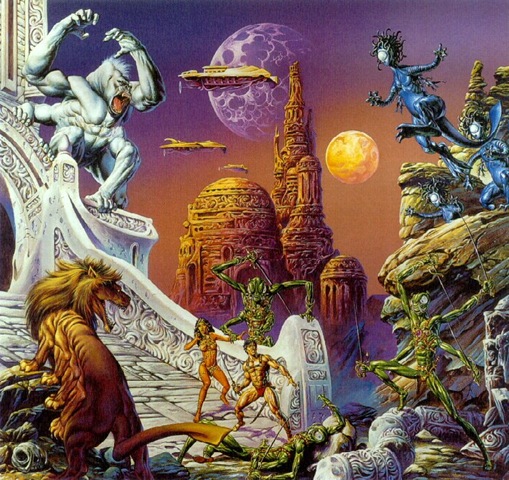
juskoerbWhen fans of science fiction think fondly upon the roots of their beloved fiction genre, most tend to think of H. G. Wells or Jules Verne.  Less commonly known of early science fiction writers was Edgar Rice Burroughs.  The same author who gained worldwide fame with his series of Tarzan stories began his novel-writing career in 1912 with "A Princess of Mars." (full text available here)

In this first of a long series of Martian adventures, we meet the estimable John Carter, a southern gentleman of Virginia who gained notoriety fighting in the Civil War.  Seeking his fortune in mining with a friend in Arizona, he discovers a mysterious cave which proves to be a kind of gateway to a world he never dreamed existed.

John Carter arrives on Mars quite to his surprise, and quickly finds himself in an exotic landscape populated with strange flora and fauna.  He soon meets the huge and warlike Green Men of Mars, standing sixteen feet in height with four arms and bristling with weapons of war.  But John Carter quickly finds out that a man of earth, with its comparatively heavy gravity, is a fearsome foe.  A leap propels him dozens of feet into the air and a single blow from his bare fist can kill a Green Man.

John Carter (no one ever calls him but by his full name) gains great fame among this heartless and savage race, securing himself a place among the hierarchy of their chieftains.  He learns their ways and discovers a wide variety of other races, creatures, and history of Mars (or Barsoom as it is called by its inhabitants).

At one point, the Green Men capture themselves an important prisoner after a violent raid on an otherwise northern race.  The city of Helium is populated by the Red Men of Mars, who besides a red tint to their skin and the fact that they lay eggs, are otherwise human.  This prisoner turns out to be the beautiful Dejah Thoris, the granddaughter of the King of Helium and the city's most prized citizen.  Of course, the Green Men immediately set out to take this prisoner to their emperor for torture and death despite Helium's desperate bargaining for her return.

John Carter decides that he will be this woman's deliverer and sets out on a path to free her from the clutches of these savages.  Adventure after adventure befalls the two and twisting intrigues unravel themselves as to the histories of various characters who aid or frustrate the hero and heroine on their path to freedom.

Forbidden Literature

A Princess of Mars is the sort of book that is liable to be banned from public libraries these days.  At one time, sex and occult content flagged a book as unacceptable for young readers.  But here we have John Carter, a confederate soldier and gentleman; just the sort of character which seems custom-tailored to alarm the sensibilities of our culture.  He refers to races upon the world of Barsoom as Red Men or Green Men, which of course to the modern (or hypermodern) mind are categories both racist and sexist.

What is worse, John Carter decides without asking to rescue the headstrong and beautiful Dejah Thoris because she is a woman and must not be left in the hands of these violent savages, regardless of what their own culture has to say about their claim on her or their right to exercise what they believe to be right.  John Carter knows such a task is certain death, but because he is a man and a gentleman, he cannot do otherwise.  Such sentiments are even more racist and sexist.

Perhaps worst of all, John Carter does not doubt the righteousness of his cause and does not waver in his convictions at any point in the book.  He is simply who he is, he can be no other.  When confronted by the strange ways of the Green Men, he does not contextualize them as deriving legitimately from a history of class warfare, dwindling natural resources, and Darwinian competition for survival (all facts he explicitly considers while learning of the world's history).  No, he condemns them as wicked and heartless, and sets about teaching them compassion and human sentiment.  When they laugh at him or do not understand, he does not flag, but rather continues his course of doing what is right, refusing to bend to the slightest compromise of conscience.  And because of this, he is a force of nature upon the face of Barsoom.

Here is a book which reminds us that the sentiments of our own day are not universal values.

Fantasy or Science Fiction?

This is science fiction on the order of Flash Gordon rather than Isaac Asimov.  The cultures and events considered are not rationalist social experiments conceived and executed in fiction.  A Princess of Mars is a milieu story about an ordinary man (or perhaps Man) coming to a strange world and discovering it through one veil at a time.  It is an adventure story of civility upended in savagery and the aftermath of that meeting.  And it is a love story that finds its roots in the archetypes of Man and Woman.  This story, for all its lush descriptions of radium pistols, gravity differentials, and Martian canals, is perhaps better seen as a fantasy than a science fiction, since virtually no plot point hangs on a rationalist impulse.

Recommendations

For those who love serial adventure stories in the vein of Indiana Jones and Conan the Barbarian, you cannot do much better than this book.  The book is action-packed, vivid, and imaginative.  But for those who prefer characters whose introspection is a fountainhead of self-doubt, for those who prefer heroines who bristle at the suggestion of rescue, for those who assume morality is a cultural construct: avoid this book.

Saturday, January 5, 2008

Review of Mainspring -- Jay Lake

The fields of fantastic fiction continue to fragment as publishers, authors, and readers refine and assert their talents and tastes. Currently in vogue is the subgenre of steampunk, a strange mix of Victorian-era trappings with postmodern dystopian sensibility. The term is young and as a result, it is less than precise, having recently been applied to writings as diverse as China Mieville's Perdido Street Station and Christopher Priest's The Prestige. Here we have a new and popular offering in the steampunk genre: Jay Lake's Mainspring.

Hethor, an orphaned horologist's (clockmaker's) apprentice is visited by a clockwork angel named Gabriel and given a mission from God: to find the Key Perilous and wind the mainspring of the world:
The angel gleamed in the light of Hethor’s reading candle bright as any brasswork automaton. The young man clutched his threadbare coverlet in the irrational hope that the quilted cotton scraps could shield him from whatever power had invaded his attic room. Trembling, he closed his eyes.

His master, the clockmaker Franklin Bodean, had taught Hethor to listen to the mechanisms of their work. But he’d found that he could listen to life, too. Hethor heard first and always his own breathing, even now heavy and slow despite his burgeoning sense of fear.

The old house on New Haven’s King George III Street creaked as it always did. A horse clopped past outside, buggy wheels rattling along with the echo of hooves on cobbles. Great steam-driven foghorns echoed over Long Island Sound. The new electrick lamps lighting the street outside hissed and popped. Underneath the noises of the city lay the ticking of Master Bodean’s clocks, and under that, if he listened very hard, the rattle of the world’s turning.

But there was no one in the room with him. No one else drew breath; no floorboard creaked. No strange smells either. Merely his own familiar sweat, the hot-tallow scent of his candle, the oils of the house—wood and machine—and a ribbon of salt air from the nearby sea.

Was this a dream?

“I am alone.” He said it as something between a prayer and the kind of spell he used to try to cast in the summer woods when he was a boy—calling on Indian lore and God’s word and dark magic from the Southern Earth and the timeless power of stone walls and spreading oaks.

Finally Hethor opened his eyes.

The angel was still there.

It no longer seemed made of brasswork. Rather, it looked almost human, save for the height, tall as his ceiling at the attic’s peak, close to seven feet. The great wings crowded the angel’s back to sweep close across its body like a cloak, feathers white as a swan. Its skin was pale as Hethor’s own, but the face was narrow, shaped like the nib of a fountain pen, with a pointed chin and gleaming black eyes. The lines and planes of the angel’s visage were sheer masterwork, finer than the statues of saints in the great churches of New Haven.

Hethor held his breath, afraid to even share the air with such perfection. No dream, this, but perhaps yet a nightmare.

The angel smiled. For the first time it appeared to be more than a statue. “Greetings, Hethor Jacques.”

With voice came breath, though the angel’s scent was still that of a statue—cold marble and damp stone. Or perhaps old metal, like a well-made clock.

Hethor dropped his grip on the blanket to grab the chain around his neck and traced the wheel-and-gear of Christ’s horofixion. “G-g-greetings . . . ,” he stammered. “And welcome.” Though that last was a lie, he felt he must say it.

“I am Gabriel,” said the angel, “come to charge you with a duty.”

“Duty.” Hethor sucked air between his teeth and lips, finally filling aching lungs with breath he had not even realized he had been holding in the strangeness of the moment. “My life is filled with duty, sir.” Duty to Master Bodean, to his studies at New Haven Latin Grammar School, to his late parents and the church and the crown.

The angel appeared to ignore Hethor’s statement. “The Key Perilous is lost.”

Key Perilous? Hethor had never heard of it. “I . . .”

“The Mainspring of the world winds down,” the angel continued. “Only a man, created in the image of the Tetragrammaton, can set it right. Only you, Hethor.”
His quest undertaken in faith, Hethor immediately sets off to meet his destiny. The narrative begins in an appropriately Dickensian fashion: the orphan child, disdained by all those around him and trod upon by those in power, stumbles about in his quest, snubbed at every turn. But it is clear from early on that Greater Powers are at work, and slowly, miraculously, events lead young Hethor by turns toward the completion of his quest.

His adventures take him across a Victorian Europe, into the high staterooms of power, and into the lowest, darkest dungeons reserved for the blackest of outcasts. In true steampunk fashion, he soon finds himself aboard an airship, Her Imperial Majesty's Ship of the Air Bassett, bound for war to protect the Crown's colonial interests. The airship brings him to still more new and strange lands and into the company of friends and foes of startling variety. Eventually, with the help of many others, our intrepid Hethor reaches the mainspring of the world and finds his destiny.

Clockwork Wonder

The lavish detail with which Lake renders his tale is easily the best quality of the book. From the earliest chapters, we have a sense that we are there with Hethor, breathing the air and hearing the clockwork whir of a world "off track." From the mire-smirched streets of a London-that-never-was to the deck of an airship, we see sights that are familiar in a nostalgic, historical sense but wholly new in exciting ways.

Once Hethor is conscripted into the crew of the Basset, things really get interesting. The further we travel from the lands of Europe into the haunted seas of the south, the more wondrous the sights become. The heart of the novel is played out against a geographic feature not found in our world: the massive equatorial wall that forms the gear track which meshes with the orbital track around the sun. The descriptions of the miles-high construct are simply breathtaking. Upon the wall are countless microcosms of which we catch only glimpses--vertical cities, hollows of vegetation and strange inhabitants, even battlefields upon which Her Majesty's forces charge clockwork monstrosities the size of houses.

Hints of Something Deeper

The beginnings of the story are thoroughly grounded in theological themes and touch on matters of philosophical importance. Biblical references abound, and not only for period-authenticity. Hethor continually finds himself confronted with questions about the nature of God, the workings of our natural world and its relationship to God, and about man's proper place before God. The central conceit of the novel, that in this world, the clockwork universe is just that: a clockwork universe, and the "evidence" for a Creator is everywhere. There are philosophical materialists who explain it away using logic both appropriate to the period and consistent with the storyworld. Everywhere are hints that something deeper is being explored than merely Hethor's desire to fulfill his divine quest.

But here lies the greatest weakness of the novel. [spoiler alert] While fascinating questions abound in the first half of the novel, we find virtually no interest in exploring these questions in its second half. Ominous angel-like villains appear, further hinting that something interesting is going to be revealed about the antagonist and his purposes, or that Hethor is in for a worldview-shaking revelation, but no such event occurs in the book. All such questions are left behind once Hethor crosses the equatorial wall and encounters "The Correct People" in the dense jungles of the far side. He journeys with them to the pole where access to the mainspring can be found, and discovers that the Key Perilous is the love he has in his heart for his lover. Hethor is briefly granted divine power with which he rewinds the mainspring of the world and also resurrects his love. The climax of the book involves violence, suffering, and action, none of which seems to connect significantly to the larger questions raised by Hethor during his journey.

Jungle Love in a Clockwork Adventure?

In the second half of the book, Hethor transitions from one world to another, entering the jungles of the southern world. Here, he encounters the Correct People, with whom he journeys to the end of the world. The Correct People are a kind of sentient Lemur-people who dwell in lush jungle, untouched (mostly) by the western and European influences that dominate the northern part of the world. It is clearly Lake's intention to show us the unspoiled quality of the southern world in all its savage nobility. The Correct People have no leaders, no institutions, and virtually no taboos. They maintain a kind of faith in God and in his messenger, but no sense of traditions or religious behaviors of any kind. As a plot device, this could have been used as a contrast to the logical thinking of the northern world. But again, Lake seems more interested in the episodic progression of the plot rather than in engaging with the questions he raises.

In a bizarre turn of events, Hethor falls in love with a female of the Correct People in all her Lemur-beauty and savage charm. Here we find ourselves with very strange and graphic sexual description. Again, in a more complex book, might have been used to some effect to explore contrasts between worlds and societies. But with its unnecessarily graphic depiction and with the lack of meaningful connection to plot or theme, it comes across as merely perverse and voyeuristic.

For the Steampunk Spectator

Lake's Mainspring work remains a brilliantly imagined exploration of a clockwork world, a winsome creation of a clockwork mind. The vistas seen from the deck of the Airship Basset are worth the read. However, one cannot help but be disappointed in Lake's handling of his weightier themes. There are two possibilities in play here: the first is that Lake raised themes natural to his story, but did not have the craft to satisfactorily bring these questions to a narrative resolution within his own storyworld. The second possibility is that he deliberately raised the questions and intentionally left them unanswered as a philosophical statement. This last is unlikely, since the shape and structure of his narrative does not support this sort of playful or querying ambiguity. Let us hope that the first is true, and that Lake will grow as a writer such that his ability to play with such themes rises to the heights of his vivid imagination.

Clockwork lovers, pick up a copy at the library and follow Hethor to the equator, savoring the sights there. But the discerning reader will want to put the book down shortly after Hethor crosses the equatorial wall, and trust to their own imaginations as to where Hethor went and what he experienced along the way.

Cross-posted to Fantastic Fictions.

Monday, December 10, 2007

Short Review of The Fortress Unvanquishable, Save for Sacnoth -- Lord Dunsany

Adventure fantasy has a long history which can be traced back to the heroic epics of our deepest written past. The brave warrior who undertakes a quest to face superhuman foes in service to his people--this is the stuff of great legend, and by the looks of the fantasy shelves at most modern bookstores, our culture's taste for it has yet to slacken.

One of the earliest modern incarnations of adventure fantasy can be found from the pen of Lord Dunsany, a prolific and talented author of fairy tales, adventure fantasy, and other tales more difficult to classify. Dunsany is one of the great stylists of fantasy literature, his prose very near to poetry. He is enjoyable in both his long and short works, which can be found in a variety of good collections. Two of his longer novels include The King of Elfland's Daughter and The Charwoman's Shadow.

The Fortress Unvanquishable, Save for Sacnoth is one of Dunsany's most beloved short tales (along with the Sword of Welleran) and stands as a flawless example of adventure fantasy. Here, Leothric seeks to free his people from the enslaving dreams of the otherworldly sorcerer Gaznak:
And still the dreams came flitting through the forest, and led men's souls into the plains of Hell. Then the magician knew that the dreams were from Gaznak. Therefore he gathered the people of the village, and told them that he had uttered his mightiest spell--a spell having power over all that were human or of the tribes of the beasts; and that since it had not availed the dreams must come from Gaznak, the greatest magician among the spaces of the stars. And he read to the people out of the Book of Magicians, which tells the comings of the comet and foretells his coming again. And he told them how Gaznak rides upon the comet, and how he visits Earth once in every two hundred and thirty years, and makes for himself a vast, invincible fortress and sends out dreams to feed on the minds of men, and may never be vanquished but by the sword Sacnoth.

And a cold fear fell on the hearts of the villagers when they found that their magician had failed them.

Then spake Leothric, son of the Lord Lorendiac, and twenty years old was he: "Good Master, what of the sword Sacnoth?"

And the village magician answered: "Fair Lord, no such sword as yet is wrought, for it lies as yet in the hide of Tharagavverug, protecting his spine."

Then said Leothric: "Who is Tharagavverug, and where may he be encountered?"

And the magician of Allathurion answered: "He is the dragon-crocodile who haunts the Northern marshes and ravages the homesteads by their marge. And the hide of his back is of steel, and his under parts are of iron; but along the midst of his back, over his spine, there lies a narrow strip of unearthly steel. This strip of steel is Sacnoth, and it may be neither cleft nor molten, and there is nothing in the world that may avail to break it, nor even leave a scratch upon its surface. It is of the length of a good sword, and of the breadth thereof. Shouldst thou prevail against Tharagavverug, his hide may be melted away from Sacnoth in a furnace; but there is only one thing that may sharpen Sacnoth's edge, and this is one of Tharagavverug's own steel eyes; and the other eye thou must fasten to Sacnoth's hilt, and it will watch for thee. But it is a hard task to vanquish Tharagavverug, for no sword can pierce his hide; his back cannot be broken, and he can neither burn nor drown. In one way only can Tharagavverug die, and that is by starving."
Leothric undertakes the dangerous task of seizing Sacnoth; then, with the might afforded him by the sword Sacnoth, he faces Gaznak and his fell minions in the Fortress Unvanquishable. For fans of fairy tale, adventure fantasy, or anyone seeking some of the most beautiful prose in the fantasy genre, this is one that must not be missed. (Full text of short story can be found here).

Cross-posted to Fantastic Fictions.